
What happens to factories when AI removes the human constraint
Every factory on earth was designed around one thing. We're about to find out what happens when you remove it.
So here's a thought that's been rattling around my head.
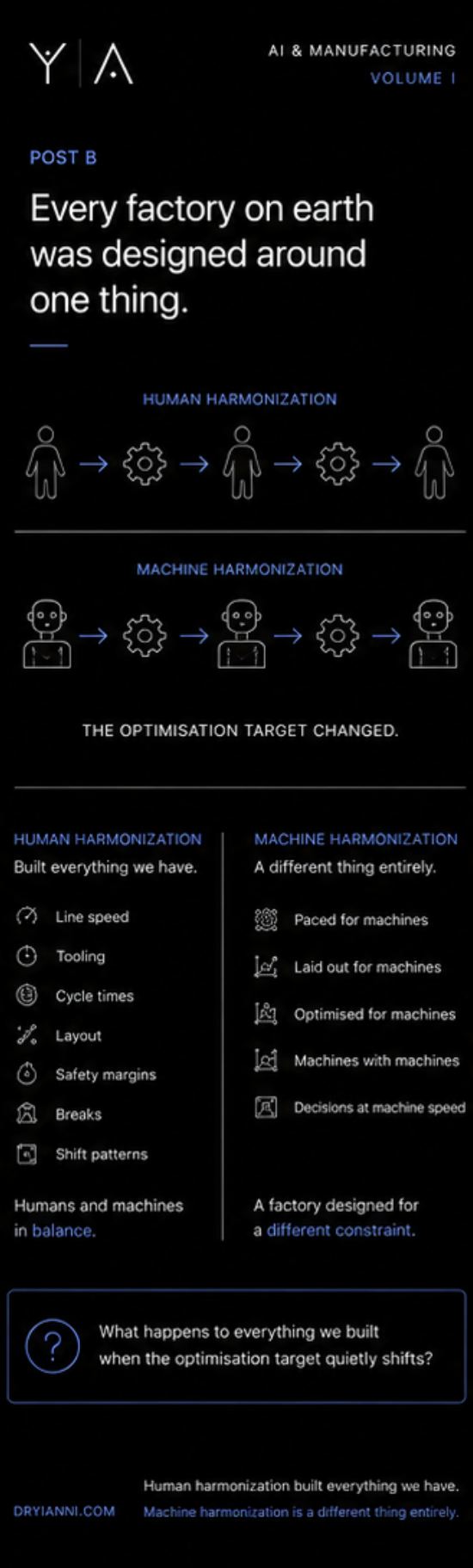
Walk into any plant, anywhere, and look at how it's built. The line speed, the tooling, the cycle times, the layout, the safety margins, the breaks, the shift patterns. All of it. Every single bit of it is a compromise built around one thing. The human. What a human body can reach, lift, see, repeat, and tolerate over an eight hour shift.
A hundred years of human harmonization
We've spent a hundred years getting really, really good at this. Call it human harmonization. The whole system, the entire art of manufacturing, is humans and machines tuned to work together, with human skill driving the thing forward. That's not a flaw. That's the achievement. It's beautiful, actually.
But here's the bit I keep turning over. That harmonization is also an assumption. And it's baked into everything.
Every machine on that floor was designed for a human to work alongside it.
What happens when the human leaves the loop
So what happens when AI starts designing the machines, and the machines don't need the human in the loop the same way? You don't get a faster version of the same factory. You get a different shape of factory entirely. Paced for machines. Laid out for machines. Optimised for a constraint that just got removed. Machine harmonization instead of human harmonization.
And that's where it gets genuinely interesting, because of what it does to everything we've already built.
Not worn out. Obsolete.
The kit on those floors right now isn't worn out. It's good for years. But if the assumption underneath it changes, it doesn't become old. It becomes obsolete. And those are really different things. Worn out, you replace on schedule, you saw it coming. Obsolete means it was perfectly fine on Friday and the wrong design on Monday, because the thing it was optimised around isn't the thing anymore.
The real disruption
So the question I find myself sitting with isn't will the robots take over. That's boring, and I don't think it's right. The question is, we built an entire physical world, trillions of pounds of it, around human harmonization. What happens to all of it when the optimisation target quietly shifts to machines? Is that the real disruption? Not AI on the floor, but AI slowly making the floor itself the old way of doing things?
I genuinely don't know the answer. But I think it's a better question than the one everyone's asking. And we're going to have to decide, on purpose, how much of the first one we want to keep.
So what do you reckon? Am I overthinking this, or is nobody thinking about it enough?
Human harmonization built everything we have. Machine harmonization is a different thing entirely.