
Why AI could make manufacturing scale out, not up
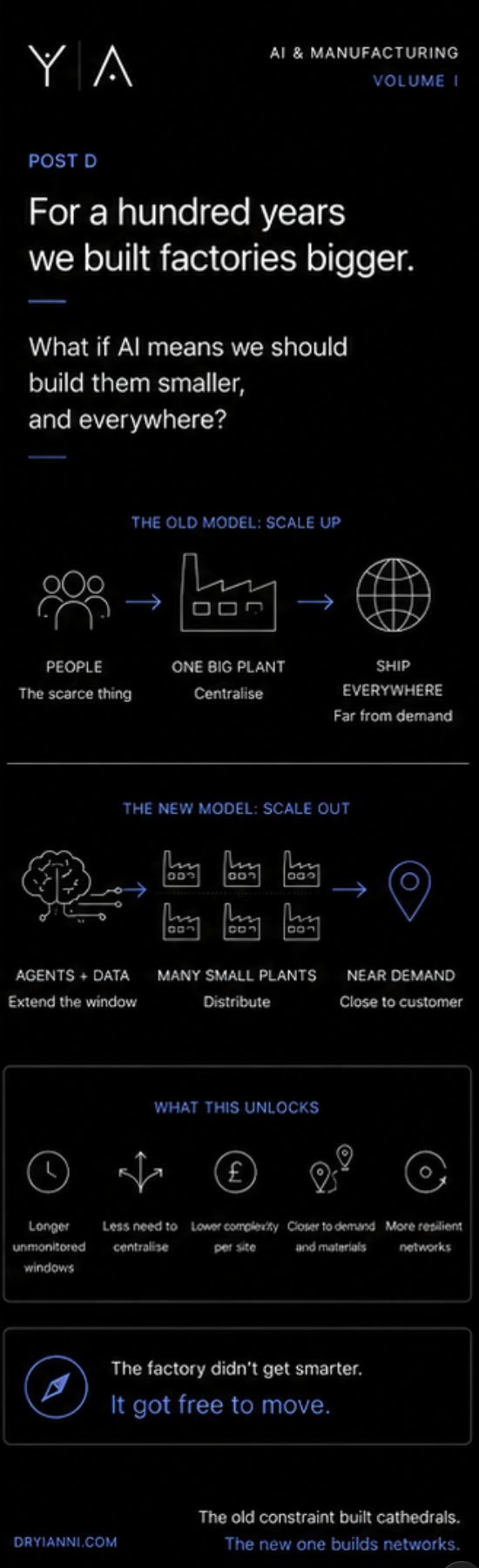
For a hundred years we built factories bigger. What if AI means we should build them smaller, and everywhere?
So I've been chewing on this one, and it goes somewhere I didn't expect.
The logic that built the 20th century
Here's the old logic, the one the whole 20th century ran on. You scale up. You build one enormous plant. You concentrate everything in it, the machines, the people, the supervision, the expertise, and you make it as big as you can, because the expensive stuff was the humans and the watching and the knowing, and the only way to afford all that was to pile it into one place and run it flat out. Centralise, amortise, ship it out to the world. That's the model. That's basically every supply chain you've ever touched.
But that model only makes sense because of one assumption. A factory needs people in it. People to run it, watch it, fix it, decide things. And people are expensive and they don't scale, so you cluster them.
What if that assumption is changing?
Now here's the question I keep coming back to. What if that assumption is the thing that's actually changing?
If agents can read a factory, watch the sensor data, catch the drift, schedule the maintenance, make the routine calls, then the amount of time a factory can run without a human standing in it gets longer. I'm not saying it runs forever untouched. It doesn't. Physical things fail in physical ways, a jam, a worn tool, a bad batch of material, and no agent unjams a machine with its hands. There's always a human somewhere.
The question isn't zero humans. It's how long the unmonitored window gets.
Scale out, not up
And the moment that window gets long enough, hours, a shift, a weekend, longer, the whole logic flips. Because if you don't need a crowd of people on site, you don't need to centralise. You stop scaling up and you start scaling out. Lots of small factories instead of one giant one. Put them next to where the demand actually is instead of next to where the labour was cheap. Distributed, not concentrated. The thing that forced everything into one big building just stopped forcing it.
That's the bit I think is genuinely under-discussed. Everyone's asking whether AI makes the factory more productive. I think the more interesting question is whether AI makes the factory free to move. Because a factory that can run mostly on its own isn't just a cheaper factory. It's a factory that doesn't have to be where it's always had to be.
A network, not a cathedral
So you get something that looks less like a mega-plant and more like a network. Small, autonomous-ish, distributed, close to the customer. Which, by the way, is a completely different industrial map than the one we have now.
So is that where this goes? Or is the human-on-site constraint stickier than I think, and the big plant wins anyway? Genuinely not sure. But I think scale-out is the question hiding underneath all the productivity talk. So what do you reckon, distributed, or am I getting ahead of the physics?
The factory didn't get smarter. It got free to move.
The old constraint built cathedrals. The new one builds networks.