
Where AI's productivity gains actually go in manufacturing
Everyone's talking about how much more productive AI makes us. Nobody's asking where the work actually goes.
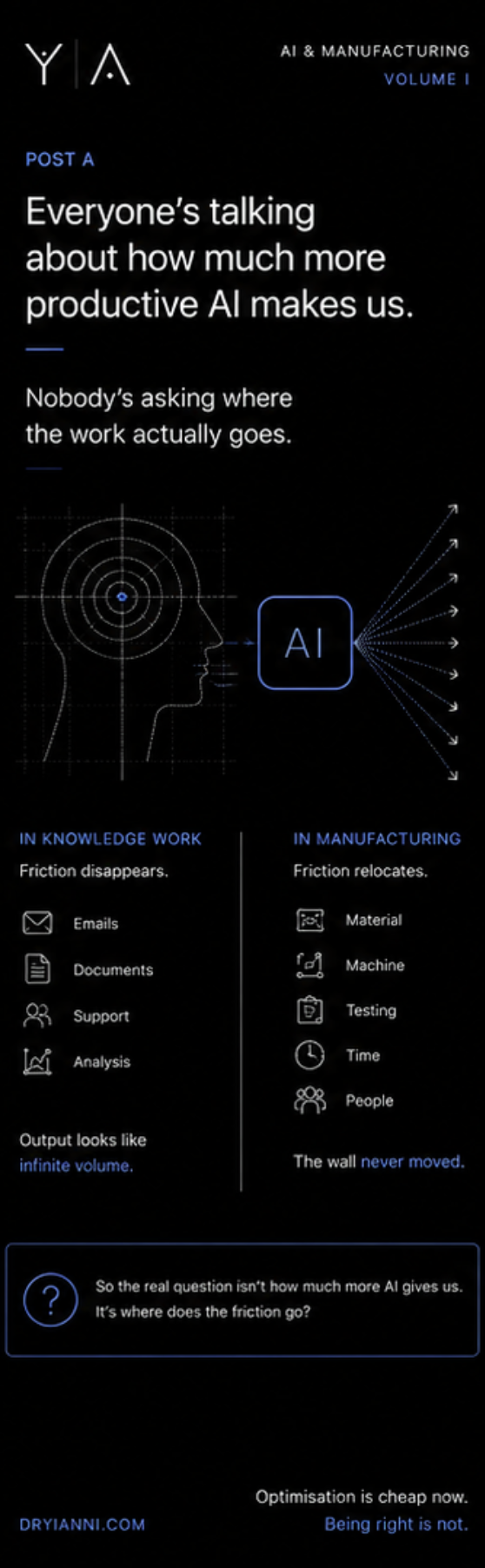
So here's the thing I keep noticing. Every productivity story about AI right now is a software story. Every hire is six hires. Agents do the work of a whole team. Output goes through the roof. And in that world, sure, I believe it. If your job is sending emails, drafting contracts, routing leads, then yeah, the agent does the boring routable bit and you move up.
But that whole story rests on one assumption nobody says out loud. It assumes output is basically free. Send more emails, generate more, draft more, the cost of one more is nothing. So productivity just looks like volume.
Manufacturing doesn't work like that
Manufacturing doesn't work like that, and this is the bit I think gets missed.
If AI makes me twice as fast at designing a part, great. I still have to cut the metal. I still have to wait for it to cool. I still have to test it. I still need the material, the machine, the floor, the time. The thinking got faster. The making didn't move an inch.
The thinking got faster. The making didn't move an inch.
So the productivity question isn't how much more does AI give us. It's where does the friction go? Because it doesn't disappear. It relocates.
Friction relocates, it doesn't disappear
In knowledge work, AI takes the friction away almost completely. That's why those numbers sound insane. Six hires, ten hires, whatever. In manufacturing, AI takes the friction out of the design and the data, forecasting, design-for-manufacture, scheduling, optimisation, and then drops you straight back against the physical wall. The wall that hasn't moved. The wall that was never going to move.
And here's what's interesting. The bottleneck doesn't go away. It gets more obvious. The smart part of the job gets ten times faster and the slow part stays exactly the same speed, so now the whole thing is just waiting on the physical world. Which is where it was always waiting.
So what do we even measure now?
A couple of real questions fall out of this, and I don't think anyone's actually answered them.
How do we even measure productivity now? If an agent optimises my line and forecasts my demand, what am I measuring against? The clever work went upstream and it went invisible. The slow work is still the thing you can see.
And the one I keep coming back to. If a layperson with an agent can do the design optimisation that used to need an expert, what's the expert for? My honest answer is the expertise didn't vanish. It moved. It moved to the one thing the agent still can't do, which is knowing whether the output is actually right before you commit it to metal.
That's the real shift. Not more output. A higher price on judgement. So tell me where I'm wrong.
Optimisation is cheap now. Being right is not.