
The Fine-Chemical Factory Already Shrank
In 2016 the FDA let Janssen switch an approved drug from batch to continuous. Almost nobody outside the industry noticed. It's one of the clearest examples we have of a factory quietly getting smaller.
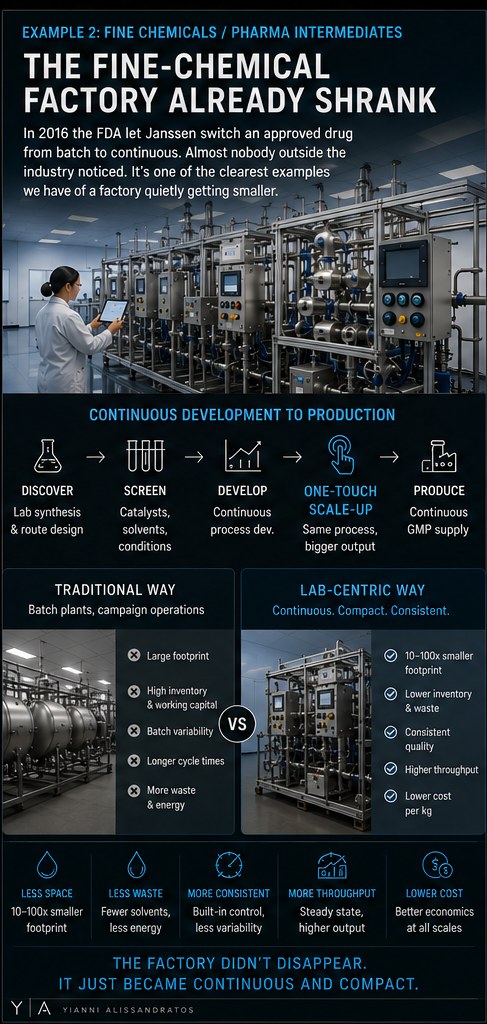
In 2016 the FDA let Janssen switch an approved HIV drug from batch to continuous manufacturing. Almost nobody outside the industry noticed.
In 2016 the FDA let Janssen switch an approved HIV drug from the old batch process to continuous manufacturing. The testing-to-release time dropped from 30 days to a target of 10. Almost nobody outside the industry noticed, and that is a shame, because it is one of the clearest examples we have of a factory quietly getting smaller.
Batch, continuous, and the fume-hood instinct
Quick translation for anyone who left the bench a while ago. Batch is the way you were taught. Make a big lot, stop, test it, release it, start again. Continuous, or flow, is the fume-hood instinct that never grew up. The reactor stays small, the material flows through it, and you make more by running it longer or adding a line, not by building a bigger vessel.
Scale by running longer, not by building bigger.
The names are not fringe
The names are not fringe. Vertex got the first fully continuous drug approved in 2015, Orkambi, for cystic fibrosis. Janssen switched Prezista the year after and now wants to make around 70 percent of its highest-volume products this way. Lilly put roughly 40 million dollars into a continuous API plant in Ireland. Pfizer, GSK, all moving in the same direction.
The financials are the whole point
Now the financials, because this is the whole point. A White House report put the prize at up to 50 percent lower manufacturing cost, with a smaller physical footprint. Smaller, faster, cheaper, and you can dial output up and down instead of committing to a giant batch you then have to sell.
The opening this creates
So here is the opening, and it is a real one. For a startup or a contract manufacturer, you no longer need a nine-figure batch plant to make a fine chemical at commercial quality. You need a compact continuous line and a regulator who will certify it. And that pathway now exists, because Vertex and Janssen already paid to build it.
The factory got smaller. Batch just had the better marketing department.
Figures are approximate, drawn from reporting in FiercePharma, BioPharma Dive and C&EN. The “up to 50 percent” figure is from a White House report via secondary reporting and is quoted as an order-of-magnitude estimate.