
Where the Coin Doesn't Flip
ExxonMobil spent hundreds of millions proving algae fuel doesn't work. That failure is the most useful thing in this series.
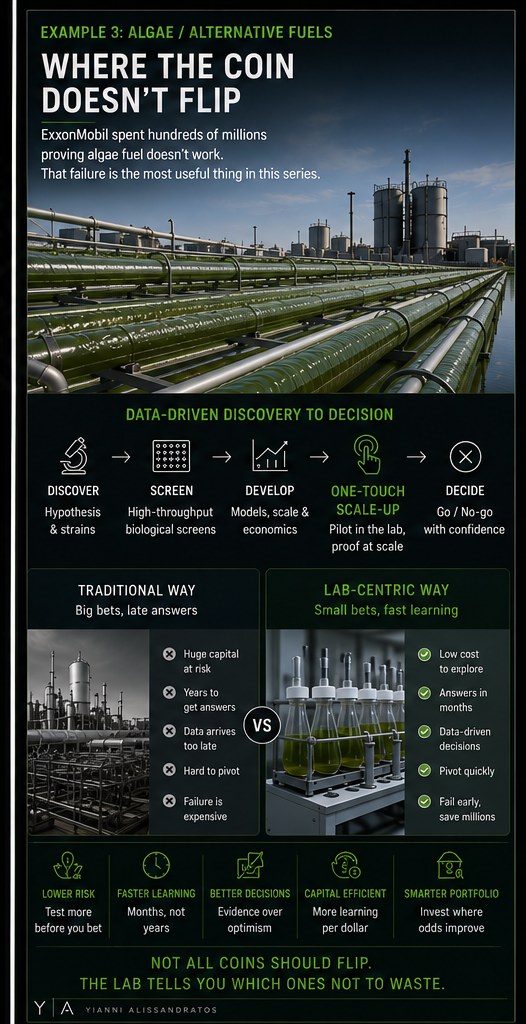
ExxonMobil spent hundreds of millions of dollars over more than a decade trying to make fuel out of algae. In early 2023 they walked away.
That failure is the most useful thing in this whole series, so let me not skate past it.
The algae pitch is genuinely seductive
The algae pitch is genuinely seductive. It grows on sunlight and CO2, it can yield many times more oil per acre than a conventional crop, and it does not fight with farmland or fresh water. Everyone from scientists to oil majors has fallen for it. So why did the player with the deepest pockets on earth give up?
Commodities punish you for scale you don't have
Because fuel is a commodity, and commodities punish you for scale you do not have. Algae biomass runs a few dollars a kilogram at best. The recovered oil lands somewhere around 2.80 dollars a litre. And diesel does not wait for you to get good. Exxon said it plainly on the way out: not at the commercial scale needed to economically replace existing energy. The physics of mass beat them. You need tonnes, hectares, light. A fume hood cannot touch this, and no clever process makes it small.
The industry didn't die. It moved.
Now the twist, because the algae industry did not die. It moved.
The same organism, the same kind of ponds, grown as Haematococcus for natural astaxanthin, sells for anywhere from 2,000 to 7,500 dollars a kilogram, sometimes higher, against a production cost that in a good case drops under 1,000. The market is heading toward a billion dollars. Same algae. The companies that survived did not crack cheap oil. They climbed the value ladder until a kilogram was worth thousands instead of pennies.
Same algae. They just climbed the value ladder.
The boundary for the whole series
So here is the boundary for everything in this series. The lab becomes a factory when the product is dense enough in value to carry the cost of small scale. mRNA clears that bar with room to spare. Fine chemicals clear it. Commodity oil never will.
Where I want to be careful about AI
And this is where I want to be careful about the AI story, because it is the whole reason I started writing about this. AI can optimise the strain. It can raise the yield, shorten the discovery loop, find the better process faster. What it cannot do is repeal the mass. Exxon did not fail for lack of intelligence. They failed because the product was worth too little to make at any scale a smart algorithm could reach.
AI optimises the strain. It cannot repeal the mass.
Figures are approximate, drawn from reporting in Mongabay, Bloomberg, Gas Outlook and CleanTechnica, and from techno-economic studies of astaxanthin production. Pricing spans several years of studies and should be read as ranges, not precise figures.